Upcoming Event: Babuška Forum
Reliable Simulations of Industrial Fluid Flow Applications
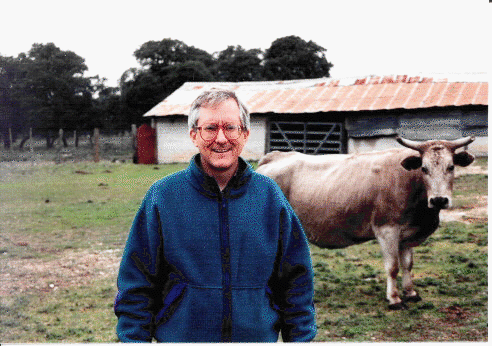
Ridgway Scott, University of Chicago
10 – 11AM
Friday Jan 23, 2026
Abstract
A new era in flight is emerging that requires a more effective simulation strategy. Many modes of transportation are being developed industrially, including air-taxi drones and ground-effect transport. Similarly, new modes of energy generation, such as blade-less wind farms have been proposed. All of these require a new level of reliability for simulations to be useful in engineering design. We will describe some computations we are doing and the flaws in standard algorithms that have been uncovered in the process. We will also describe some open problems related to these and some prizes being offered for their solution.
Biography
L. RIDGWAY SCOTT is professor emeritus at the University of Chicago. He obtained the B. S. degree (Magna Cum Laude) from Tulane University in 1969 and the Ph. D. degree in Mathematics from the Massachusetts Institute of Technology in 1973. His thesis and later research were devoted to fundamental properties of the finite element method, the most widely used computational technique for engineering design and analysis. He was an L. E. Dickson Instructor in Mathematics at the University of Chicago from 1973-1975. From 1975-1978 he held positions at the Brookhaven National Laboratory. In 1978, he was appointed Assistant Professor of Mathematics at the University of Michigan in Ann Arbor. In 1980, he was promoted to Associate Professor of Mathematics, with tenure, and in 1984 he was promoted to the rank of Professor. At Michigan, Professor Scott was a founding member of the Advanced Computer Architecture Laboratory, an early center for the study of parallel computing and a ``beta-site" for one of the first-generation of hypercube computers, the nCUBE-1. In 1986, he became Professor of Computer Science and of Mathematics at the Pennsylvania State University where he helped to establish a program in parallel scientific computing which became a ``beta-site" for the second-generation Intel hypercube, the iPSC-2. He also co-founded what later became the W.G. Pritchard Fluid Mechanics Laboratory at Penn State. At the University of Houston, Professor Scott continued his research on the finite element method as well as parallel computing. In addition, he initiated collaborations with researchers in the Department of Chemistry at the University of Houston and at Baylor College of Medicine to develop enhanced computational techniques in structural biology. From 1992 to 1998, he was the Director of the Texas Center for Advanced Molecular Computation, a National Science Foundation Grand Challenge Application Group. At the University of Chicago, Professor Scott is continuing his research in all these areas. He was a Member of the Executive Committee of the ASCI Flash Center and is a founding member of the Institute for Biophysical Dynamics at the University of Chicago. He was a founding co-Director of the Argonne/Chicago Computation Institute which was established in spring, 1999. He was also the director of the University of Chicago partnership in the The National Partership for Advanced Ccomputational Infrastructure (NPACI) based at SCSC/UCSD.
Event information
Friday Jan 23, 2026